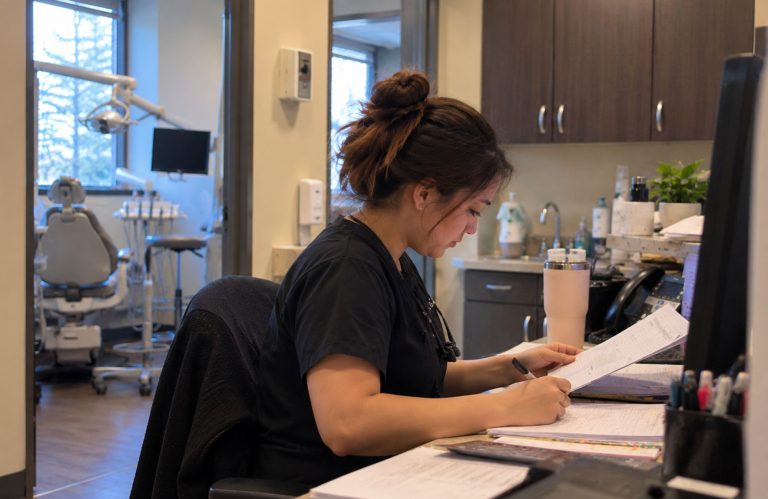
Dental practice payroll means paying hygienists, assistants, and front office staff correctly, then filing the right payroll taxes. Most dental team members are hourly and eligible for overtime. The tricky part is production bonuses, because they change how much overtime you owe.
This guide covers who is on a typical dental payroll, how overtime works with bonuses, and what payroll percentage practices usually aim for. It also explains how to set up a payroll system that keeps the office compliant without eating your lunch hour.
Who is on a dental practice payroll?
A small dental practice usually pays four kinds of workers: hygienists, dental assistants, front desk staff, and an office manager. Associate dentists may be employees or contractors, depending on how the practice controls their work.
Hygienists need special attention. According to the U.S. Bureau of Labor Statistics, many hygienists work part time, and some work for more than one dentist. BLS also projects hygienist jobs to grow 7% from 2024 to 2034, much faster than average. In a tight hiring market, a paycheck error can cost you a good hygienist.
Are dental hygienists and assistants owed overtime?
Usually, yes. Most dental assistants and hygienists are non-exempt, so they earn time and a half for hours over 40 in a workweek. Paying someone a salary does not make them exempt on its own.
To be exempt under federal law, an employee must earn at least $684 per week on a salary basis and pass a duties test. Some states set a higher salary floor. When in doubt, treat the role as non-exempt and track hours. Our guide to overtime rules for small businesses explains both tests.
How do production bonuses affect overtime pay?
A production bonus that employees expect, like a set percentage of a hygienist’s collections, counts toward the regular rate. That raises the overtime rate for any week with more than 40 hours. Many dental offices miss this step.
Worked example: a hygienist with a production bonus
This is an illustrative example, not real practice data. A hygienist earns $45 per hour, works 42 hours, and earns a $210 production bonus that week.
| Step | Calculation | Result |
| Straight-time pay | 42 hours x $45 | $1,890 |
| Add production bonus | $1,890 + $210 | $2,100 |
| Regular rate | $2,100 / 42 hours | $50.00 |
| Overtime premium | 2 hours x ($50 / 2) | $50.00 |
| Total pay | $2,100 + $50 | $2,150 |
If the office ignored the bonus, overtime would be based on $45, and the hygienist would be $5 short. That seems tiny. However, it repeats every busy week, and wage claims can reach back two years or more. For more on which bonuses count, see our guide to discretionary vs non-discretionary bonuses.
What should the payroll percentage be for a dental office?
There is no legal rule, but many dental practice consultants point to staff wages landing at roughly a quarter of collections, not counting the dentist’s own pay. Treat that as a rough benchmark. Your market, team size, and services shift the right number.
Track the number monthly, not yearly. I have seen practices notice a staffing cost creep only at tax time, long after it could have been fixed. A payroll system that tags hours by role makes this easy to watch.
How do you set up a payroll system for a dental office?
Start with the basics every employer needs, then add the dental-specific pieces. Get your EIN, register with your state tax and unemployment agencies, and collect W-4 and I-9 forms from each hire. Then set up pay rates and bonus rules, using the key steps below.
- Classify each role correctly, especially associate dentists and part-time hygienists. Our W-2 vs 1099 guide walks through the tests.
- Set up separate pay codes for hourly pay, production bonuses, and paid time off.
- Use digital time tracking so overtime is based on real hours. Our guide to employee time tracking software compares the options.
- Track license and certification renewal dates alongside employee records.
- Run a quick payroll audit each quarter using a payroll compliance checklist.
If you are moving off an older system, timing matters. Read our guide on switching payroll providers mid-year before you start.
Why FRIDAY fits small dental practices
FRIDAY runs payroll and time tracking in one place. Your front desk tablet becomes a time clock with facial recognition or PIN sign-in, so hygienists and assistants clock in where they work. Approved hours then flow into payroll, and FRIDAY files federal, state, and local payroll taxes.
Staff can view pay stubs and tax forms in the employee portal, in English or Spanish. FRIDAY also syncs with QuickBooks Online and Desktop, so your accountant sees clean records. You can try it free for 14 days, with free migration from your current provider.
FAQs
Do dental hygienists get paid overtime?
Most dental hygienists are non-exempt and earn overtime for hours over 40 in a workweek. A salary alone does not make a hygienist exempt. They must also meet the federal salary threshold and duties test.
Are production bonuses included in overtime?
Yes, expected production bonuses are usually included in the regular rate. That raises the overtime rate for any week with overtime hours. Bonuses given purely at the owner’s choice may be excluded.
Can a dental office pay hygienists as 1099 contractors?
Usually not. If the practice sets the schedule, supplies the equipment, and directs the work, the hygienist is likely an employee. Misclassification can lead to back taxes and penalties.
How often should a dental office run payroll?
Most dental offices run payroll weekly or every two weeks. Pick one schedule and stick with it, since many states set minimum pay frequency rules. A steady schedule also helps keep staff happy.
Disclaimer: This article is for general information only and does not constitute tax, legal, or accounting advice. Payroll, wage, and tax rules change and vary by state. Confirm your obligations with a qualified tax professional or the relevant government agency before making payroll decisions.

Pincus Schiff is a payroll software specialist at Friday App, where he helps businesses simplify payroll, stay compliant, and automate their workflows. He writes about payroll best practices, compliance, and the latest in workforce technology.